Tecnológico Universitario Rumiñahui

Menu
Admissions
RU Campus
About RU
- History
- Accreditation
- Rector’s Message
- Governance and Administration
- Institutional Planning
- Philosophy
- About Us
- Ethics and Transparency
- General Regulations
- Institutional Policies
- Accountability
- Organizational Chart
- Code of Ethics
Communications
Quality Assurance
Contact Us
- Main Campus
- Av. Atahualpa 1701 y 8 de Febrero – Sangolquí
- (02) 352-4576 / (02) 233-1628
- info@ister.edu.ec
Social Media
ABOUT THE UNIVERSITY TECHNOLOGY PROGRAM
Programa orientado a la formación de profesionales en emergencias médicas y atención prehospitalaria.
- Bachelor of Technology in Medical Emergencies
- Duración: 2½ años
- Modalidad: Presencial
- RPC-SO-50-No.839-2023
- BROCHURE
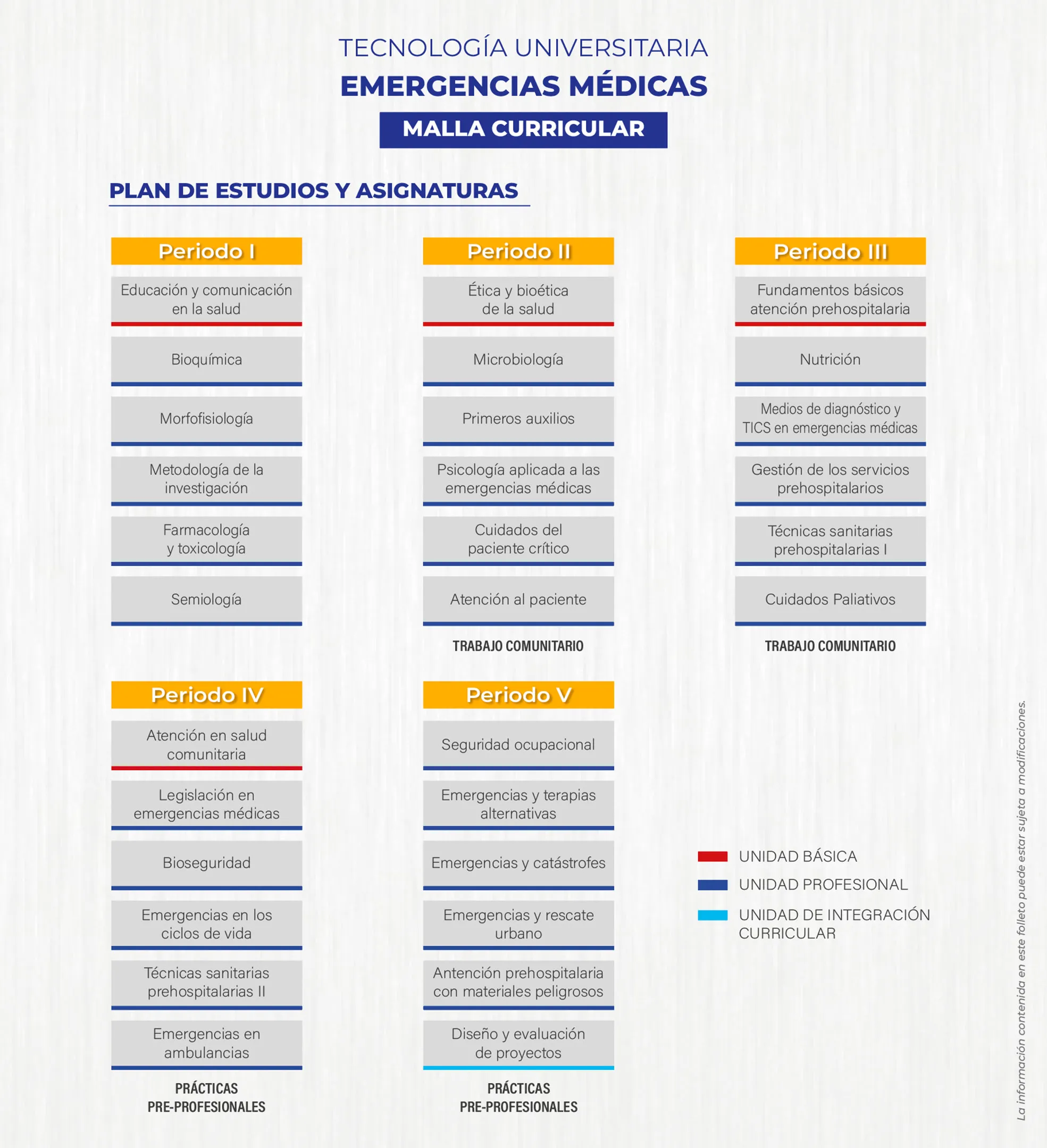
- Malla Académica
Prospective students for the Medical Emergencies Technology program must demonstrate:
- Vocación de servicio y compromiso humanitario, con interés en brindar ayuda oportuna a personas en situaciones críticas de salud.
- Capacidad para trabajar bajo presión, tomar decisiones rápidas y mantener la calma en situaciones de emergencia.
- Condiciones físicas y emocionales estables, que le permitan actuar con eficacia y responsabilidad en entornos exigentes.
- Habilidades comunicativas y sociales, necesarias para interactuar adecuadamente con pacientes, familias y equipos interdisciplinarios.
- Interés por las ciencias de la salud, especialmente en el área de atención prehospitalaria y primeros auxilios.
- Core values such as empathy, ethics, accountability, and respect for life and cultural diversity.
- Disponibilidad para el aprendizaje práctico en escenarios reales o simulados, con compromiso hacia la formación continua.
This profile ensures that students possess the necessary aptitudes to excel in the field of medical emergency services.
Graduates in Medical Emergencies Technology are qualified to provide timely, efficient, and safe pre-hospital care during critical health crises. They evaluate patients, identify abnormal vital signs, implement emergency protocols, perform first aid, and operate specialized medical equipment under clinical supervision.]
They possess the skills to manage trauma, cardiac arrest, respiratory emergencies, and other critical events by applying techniques such as CPR, medication administration, and the use of defibrillators. They work in coordination with other healthcare professionals, fire departments, and law enforcement, demonstrating leadership, ethical conduct, and effective communication.
Furthermore, they utilize triage methodologies, respect cultural diversity, and act with responsibility, empathy, and confidentiality, contributing to life-saving efforts, risk reduction, and the improvement of patient outcomes in emergency settings.
The Medical Emergencies Technologist is a professional trained to provide immediate, effective, and safe pre-hospital care in critical health situations under medical supervision. Their training enables them to act with speed, precision, and integrity in urgent, emergent, and disaster scenarios, prioritizing human life and well-being.
This professional:
- Evaluate and stabilize critical patients by applying established protocols and specialized life-support techniques.
- Administer emergency medications and treatments in accordance with medical orders and current regulations.
- Coordinate operations with multidisciplinary teams, including physicians, nurses, firefighters, police officers, and rescue personnel.
- Apply triage procedures to prioritize care based on patient acuity.
- Perform basic and advanced CPR, trauma management, and care for respiratory, cardiovascular, and neurological emergencies.
- Operate specialized medical equipment (defibrillators, monitors, ventilators, etc.) safely and efficiently.
- Maintain clear, empathetic, and effective communication with patients, families, and colleagues in high-stress situations.
- Operate under ethical principles, respecting human rights, cultural sensitivity, and social inclusion.
The Medical Emergencies Technologist is a fundamental pillar in the chain of survival, providing professionalism, compassion, and technical expertise in emergency care.
El Tecnólogo en Emergencias Médicas puede desempeñarse en una amplia variedad de entornos donde se requiere atención inmediata y especializada ante situaciones de urgencia y emergencia, tanto en el sector público como privado. Su campo laboral incluye:
Healthcare and Emergency Institutions
- Pre-hospital care units (public or private ambulance services)
- Hospitals and clinics (emergency, trauma, and urgent care departments)
- Primary healthcare centers with urgent care services
Response and Rescue Organizations
- Fire departments
- Red Cross
- Civil Defense
- Urban Search and Rescue (USAR) teams
- Armed forces or security agencies (serving as operational paramedics)
Transport and Security Systems
- Airports, seaports, and land transport terminals (within medical brigades)
- Air or ground emergency medical transport companies
- Security and surveillance operations centers
Private Sector and Corporate Environments
- Private ambulance companies
- First aid and medical response brigades within industrial and high-risk corporate settings
- Health and accident insurance companies
- Training centers for first aid and medical emergencies
Educational and Community Spheres
- Facilitators for training programs in first aid, CPR, and emergency care
- Health prevention and promotion projects in vulnerable communities
El profesional puede además integrarse a programas de salud pública, resiliencia ante desastres o emergencias humanitarias, participando activamente en la reducción del riesgo y en la respuesta efectiva ante crisis sanitarias o naturales.
| Description | Level 1 | Level 2 | Level 3 | Level 4 | Level 5 | Total |
|---|---|---|---|---|---|---|
| Enrollment Fee | $90 | $90 | $90 | $90 | $90 | $450 |
| Tuition Fees | $910 | $910 | $910 | $910 | $910 | $4500 |
| Total | $1.000 | $1.000 | $1.000 | $1.000 | $1.000 | $5.000 |
Accredited by:



Formulario de registro
Llena los campos del formulario para iniciar tu proceso de matrícula
Solicita información de la Tecnicatura Superior
AN EDUCATION TAILORED TO YOUR NEEDS
EXPLORE ALL OUR PROGRAMS.
Start your future with us
Once your decision is made, all that remains is to discover the next steps. Remember that we provide assistance in financing your program and offer scholarships, financial aid, and credit transfers as part of your application.