
ABOUT THE UNIVERSITY TECHNOLOGY PROGRAM
Programa orientado a la formación de profesionales en infraestructura tecnológica, redes y seguridad informática.
- Tecnólogo Superior Universitario en Infraestructura de Redes y Cyber Seguridad
- Duración: 2½ años
- Modalidad: En línea
- RPC-SO-42-NO.714-2023
- BROCHURE
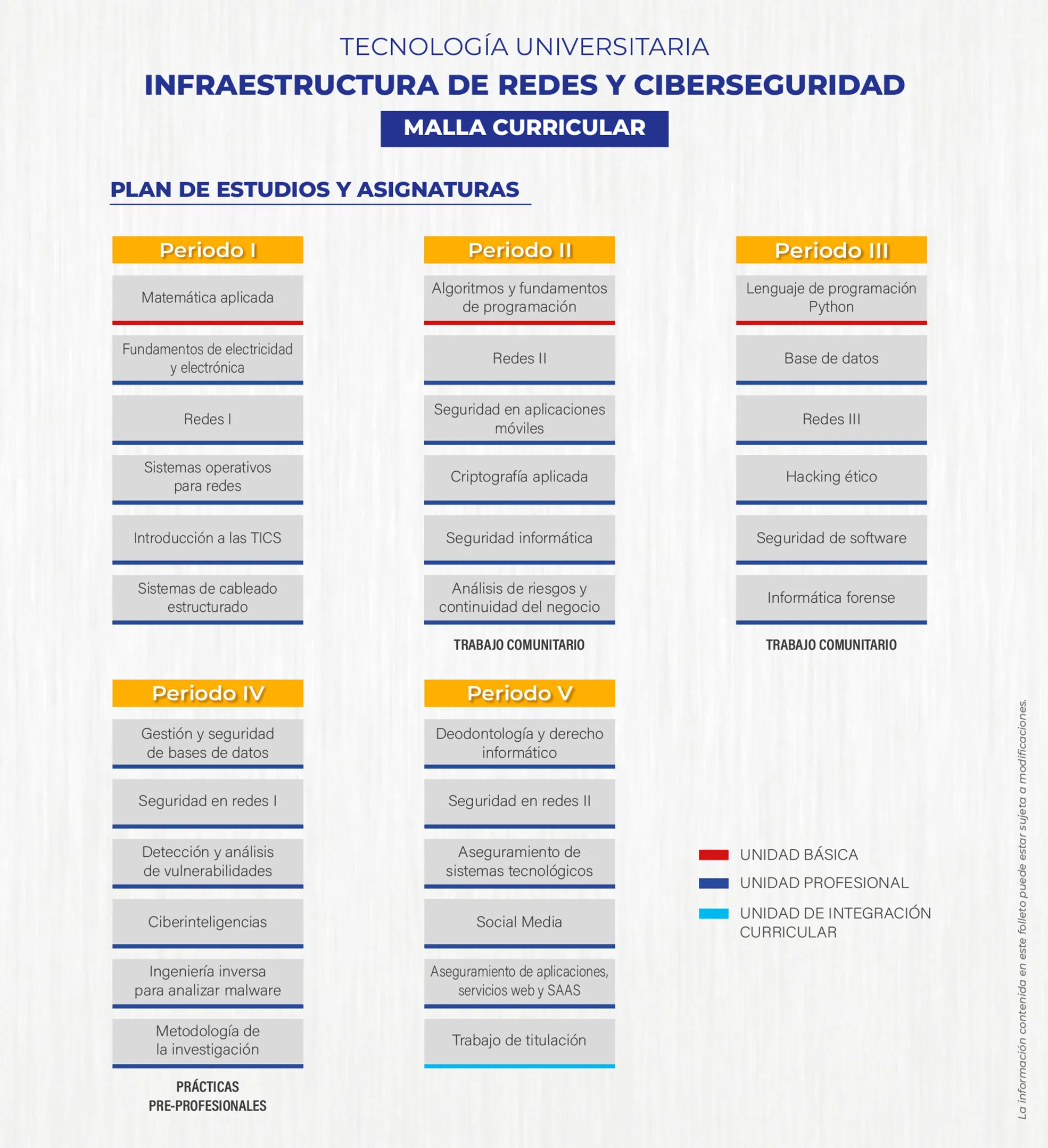
- Malla Académica
The University Technology program in Network Infrastructure and Cybersecurity is designed to train professionals with the competencies required to protect systems and critical assets from both physical and cyber threats, safeguarding information, preventing cyberattacks, preserving privacy, and ensuring business continuity within organizations.
This program enables professionals to:
- Configure and maintain network infrastructure and security systems, including firewalls, switches, routers, and servers.
- Install, maintain, and monitor data networks.
- Apply regulations, strategies, standards, and procedures to ensure the security of technological infrastructure.
- Configure and manage security systems such as Intrusion Detection Systems (IDS) and Intrusion Prevention Systems (IPS).
Applicants must hold a high school diploma and demonstrate an interest in information technologies, communication networks, and cybersecurity. Candidates are expected to have foundational skills in mathematics, logical reasoning, and the use of digital tools.
Analytical thinking, technical problem-solving abilities, a critical and creative mindset, and a willingness to work collaboratively are highly valued. Applicants should also demonstrate responsibility, professional ethics, and a commitment to continuous learning in a rapidly evolving technological environment.
Graduates are trained to implement, configure, and maintain local area networks (LANs), both wired and wireless, as well as cybersecurity systems under technical supervision. They operate devices such as firewalls, switches, routers, and servers, applying protocols, standards, and security policies to protect technological infrastructure.
They use forensic analysis tools and ethical hacking practices to identify vulnerabilities and strengthen organizational cybersecurity. They prepare technical reports on security incidents and ensure the integrity, confidentiality, and availability of information.
They contribute to productive and social development by securing networks that ensure the privacy and functionality of devices, including those within the Internet of Things (IoT). They promote values such as respect, equality, social justice, intercultural awareness, and critical thinking, acting with ethics, integrity, and responsibility to enhance quality of life and foster trust in the digital economy.
Professionals are qualified to configure, maintain, and manage network infrastructure and security systems, including firewalls, switches, routers, and servers. They install, supervise, and optimize both wired and wireless data networks, applying current standards and regulations to ensure optimal service delivery.
They rigorously apply cybersecurity standards and policies, using a range of protocols to ensure network connectivity and infrastructure protection. Additionally, they utilize specialized tools for forensic analysis and for implementing comprehensive security strategies in telecommunications networks.
- Configure and maintain network infrastructure and security systems, including firewalls, switches, routers, and servers.
- Install, maintain, and monitor data networks.
- Apply cybersecurity standards.
- Use digital tools for forensic analysis.
- Implement and maintain telecommunications networks (wired and wireless), applying current standards to ensure optimal service delivery.
- Execute cybersecurity strategies and policies across data networks.
- Use various protocols to configure network connectivity.
- Apply security strategies and policies to protect technological infrastructure.
- Network Administrator: Network configuration and maintenance.
- Network performance monitoring.
- Implementation of security policies.
- Cybersecurity Specialist: Vulnerability analysis and risk assessment.
- Implementation of security measures to protect infrastructure.
- Incident response management.
- Design and implementation of network infrastructure.
- Network performance optimization.
- Troubleshooting and problem resolution.
- Information Security Consultant
- Advising organizations on cybersecurity best practices.
- Development of security policies.
- Information Security Analyst: Security event monitoring.
- Security incident analysis.
- Implementation of security controls.
- Digital Forensics Specialist
- Administration and maintenance of data and telecommunications networks.
- Management and monitoring of cybersecurity systems.
- Digital forensic analysis and cybersecurity incident response.
- Implementation of security policies and protocols across technological infrastructures.
- Cybersecurity consulting and network auditing.
- Specialized technical support for firewalls, routers, switches, and servers.Select 91 more words to run Humanizer.
Accredited by:



Formulario de registro
Llena los campos del formulario para iniciar tu proceso de matrícula
Solicita información de la Tecnicatura Superior
AN EDUCATION TAILORED TO YOUR NEEDS
EXPLORE ALL OUR PROGRAMS.
Start your future with us
Once your decision is made, all that remains is to discover the next steps. Remember that we provide assistance in financing your program and offer scholarships, financial aid, and credit transfers as part of your application.